What’s the Difference Between Oil and Water Based Paint?
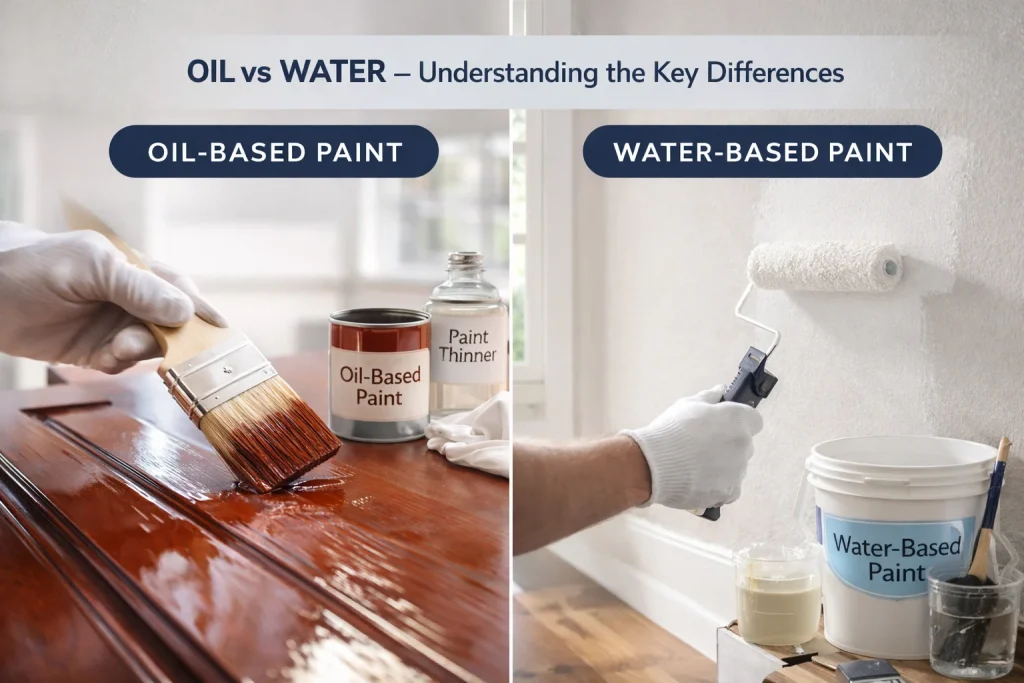
Water-based paint dries faster, has low odour, and cleans up easily, while oil-based paint provides a harder, more durable, moisture-resistant finish for trim.
It may have happened to you that you were standing in a hardware store, looking at shelves full of paint tins. You were probably thinking about one simple question:
Should you choose Oil or Water Based Paint?
You are not the only one to get confused between these two paints. A lot of people just grab paint oil or water based paint without knowing the usage of these two paints. But remember, you make a smarter decision when you understand their differences.
So let’s understand both of them in this blog.
At Final Touch Painting & Decor, we provide high-quality residential and commercial painting services across Perth. We have three decades of experience, so take advantage of our experience and get a high-quality paint job, which will also increase the value of your property.
What Is Paint Actually Made Of?
Before we start to compare any thing lets first know what paint contains. Paint has three main ingredients:
- Pigment which gives the paint its colour.
- Binder, which basically helps the paint stick to your wall or surface.
- Solvent keeps the paint in liquid form until you apply it.
Now, let’s talk a bit about the difference before we go deep into it. When it comes to oil in paints, the binder is usually a synthetic oil (alkyd), and the solvent is mineral spirits. On the other hand, in water-based formulas, the solvent is water, and the binder is acrylic or latex polymer.
What Is Oil Based Paint?
Oil based paint uses oil-modified binders and chemical solvents instead of water.
When you apply, it will give a thick and smooth finish. People love it for trims and doors because it levels out nicely. On applying, you will notice:
- Strong smell
- Slower drying time
- Very smooth, glossy finish
- Hard, durable surface
When oil paint dries, it also cures through oxidation. That means it reacts with air and hardens over time. That’s why oil-based coatings are often used for skirting boards, cabinets or metal surfaces.
What Is Water Based Paint?
Now let’s talk about water-based paint. It mainly uses water to keep it liquid instead of chemical solvents. The binder is usually acrylic or latex. When you apply it:
- It dries quickly
- It has a low odour
- It’s easier to clean up
- It feels lighter to work with
There is no complex curing reaction; it dries because the water evaporates.
Now, there are modern water-based paints in market. They’re flexible, meaning they expand and contract slightly with temperature changes instead of cracking. This feature makes a big difference, especially here in Australia, where temperatures change a lot.
Oil vs Water-Based Paint | Key Differences
Now, let’s properly compare water-based or oil-based paint so that no confusion will be left for you.
1. Drying Time
You must have an idea that if you want to finish your project in one weekend, drying time matters a lot. Water and oil-based paints have different drying times,
Water-based:
- Touch dry in 1 to 2 hours
- Ready for another coat within 4 hours
Oil-based:
- Touch dry in 6 to 8 hours
- May need 16 to 24 hours before recoating
2. Smell & Ventilation
Smell makes a huge difference if you’re painting your bedroom or study space. Oil-based paint releases higher levels of VOCs (volatile organic compounds). On the other hand, water-based paint has lower VOC content, making it better for indoor air quality.
Suppose that you finally decide to repaint your bedroom during school holidays. You pick oil paint because it looks stronger. You finish late afternoon. But on that night, the fumes are so strong you can’t sleep, your windows are kept open, and the whole house smells for days. So we can see that drying time and ventilation are real problems.
3. Durability & Surface Hardness
Oil-based paint forms a harder, enamel-like surface. Because of these features, it can resist:
- Scratches
- Heavy cleaning
- Impact
Water-based paint is slightly softer and more flexible. Modern acrylic technology has significantly reduced the durability gap.
4. Colour Retention & Yellowing
Oil-based paints can yellow over time, especially white shades in low-light areas. Water-based paints maintain colour stability much better.
5. Cleanup Process
Do you know easy cleanup process is one of the biggest reasons many homeowners now prefer water-based systems? Yes its true because oil-based paint requires mineral spirits or turpentine for cleaning brushes. In contrast, water-based paint only needsSoap and water for cleaning.
How to Tell if the Paint is Oil or Water Based
If you’re unsure what’s underneath when you are repainting. You can do this simple test.
Rubbing Alcohol Test
- Dip a cotton ball in methylated spirits.
- Rub it on a small hidden area.
If paint comes off, then it’s water-based. In contrast, if nothing happens, then it’s oil-based.
By using this simple trick, you will check which material you are going to repaint. And you don’t have to guess.
Where Each Type Works Best
You don’t always need the strongest coating. You need the right one. It is not necessary to use the strongest coating, but what matters is the right coating.
Best for Oil-Based Paint
It provides that classic enamel finish that people like.
- Timber trims
- Interior doors
- Cabinets
- Metal railings
- High-wear surfaces
Best for Water-Based Paint
It dries faster, smells less, and makes your life easier.
- Interior walls
- Bedrooms
- Ceilings
- Large surface areas
When choosing between oil and paint options for interior projects, most professionals now recommend modern acrylic water-based systems unless extreme durability is needed.
Pros and Cons of Oil or Water Based Paint
Type | Pros | Cons |
Oil Based |
|
|
Water Based |
|
|
How You Can Decide?
There isn’t one perfect answer. Always ask these simple questions to make a better decision.
- Is this indoors or outdoors?
- Do you need a quick turnaround?
- Is ventilation limited?
- Does the surface get heavy wear?
If convenience, air quality, and speed matter most, water-based is by far a wiser choice.
Oil-based may also be a worthwhile investment in case you have the desire to be as hard as possible and still have that classic enamel finish.
Final Thoughts
Now you understand the differences clearly. Oil-based gives you hardness and smooth gloss. On the other hand, water-based gives you flexibility, easier application, and faster drying. So next time you walk into a paint store, you’ll exactly know what you’re buying.
At Final Touch Painting & Decor, we deliver expert residential and commercial painting services with a focus on quality and long-lasting results. Get in touch with us and let us transform your space with a flawless finish.